
In September 2023 a capsule the size of a car tire fell out of the sky over the Utah desert and drifted down under a parachute. Inside was a few spoonfuls of black grit, scraped off an asteroid called Bennu, three hundred million kilometers from here. When chemists finally opened the container, they found something that would have read as science fiction a generation ago. Amino acids, the parts that build every protein in your body. And all five of the letters that life uses to spell out DNA and RNA. Ingredients for life, mailed in from deep space, in a sealed can, with no chance that anything from Earth had snuck in.
The headlines wrote themselves. We are closing in, they said, on how lifeless chemistry first sparked into living biology. Some went further. Maybe life is not a lucky accident at all. Maybe it is written into the laws of physics, bound to appear on any world where the conditions are right, the way water is bound to freeze once it gets cold enough.
Some of that is true, and the true part is genuinely thrilling. But three very different achievements keep getting folded into one story, and they answer three different questions. The first is solid, measurable, and quietly astonishing, and it is the one nobody bills as solving the origin of life. The second is the grand claim in the title, that physics makes life inevitable, and its fame has sprinted well past its evidence. The third is the actual event, the moment chemistry became alive, and no one has ever made it happen.
Think of them as three different verbs. We can find life’s ingredients. We can argue that they had to combine. And we would like to explain how they actually did. Only the first is really working.
The one that works, and it only finds
Start with the solid result, because it does the most and oversells the least.
The story starts in a flask. In 1953 a graduate student named Stanley Miller filled a glass apparatus with the gases people then believed had wrapped the young Earth, methane, ammonia, hydrogen, and water vapor, and ran sparks through it to play the part of lightning. A week later the water at the bottom had turned brown. In it were amino acids, the building blocks of proteins, made from nothing but gas, water, and electricity. It became the most famous experiment in the history of the question. Life’s parts, it seemed, would assemble themselves given a little energy and a plausible sky.
There was a catch, and it took decades to surface. Miller’s recipe assumed an early atmosphere rich in hydrogen, the chemical equivalent of a tailwind. Most geoscientists now think the real early air was tamer, closer to carbon dioxide and nitrogen, and in that milder mix the classic spark makes far fewer amino acids. The experiment was not wrong so much as lucky in its assumptions. The lesson stuck anyway, and later work rescued it: rerun the spark over a volcanic plume, where the local chemistry really is hydrogen-rich, and the amino acids come pouring back, even more of them than Miller first reported.
Then the ingredients started turning up on their own, without anyone running an experiment at all. In 2023, in dust that Japan’s Hayabusa2 mission brought back from the asteroid Ryugu, chemists found uracil, one of the four letters of RNA, along with a form of vitamin B3. Two years later the Bennu sample went further still. It held 33 different amino acids, 14 of the 20 that life uses to build proteins, and all five of the nucleobases, the full alphabet of DNA and RNA. It carried ammonia in surprising amounts and traces of salt left behind by long-vanished water, hints that Bennu’s parent body was once a wet, briny little world doing chemistry of its own.
Put the flask and the asteroids together and the picture is hard to miss. Life’s building blocks are not rare or delicate. They form easily, in a jar on a bench, in the cold dark between the planets, on the backs of asteroids, apparently anywhere the raw materials meet a jolt of energy. The parts are cheap, and they are everywhere.
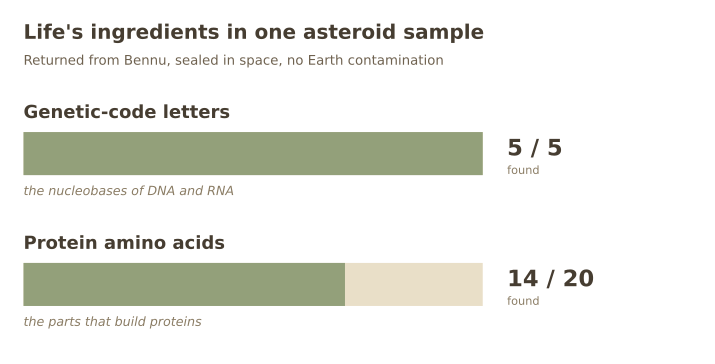
But look closely at what all of this does. Every one of these results finds life’s ingredients. Not one of them makes life. A warehouse full of bricks, timber, glass, and wire is not a house, no matter how full the warehouse gets. We have discovered that the universe is generous with bricks. That is a real and wonderful discovery. It says nothing yet about how you get a house.
The famous one that says physics makes it inevitable
Now the idea that actually claims to answer the title, and whose fame has outrun its proof.
In 2013 a young physicist named Jeremy England published a short, dense paper with a large ambition. He was not hunting for a missing molecule or a better flask. He was asking whether life is a consequence of thermodynamics itself, the branch of physics that governs heat and energy and disorder. His argument, which he later called dissipation-driven adaptation, runs roughly like this. Pour energy steadily into a clump of matter, sunlight into a warm pond, say, and the matter does not just sit there. It tends to rearrange itself into forms that soak up that energy and shed it as heat more effectively. And one supremely good way to dissipate more energy, England pointed out, is to make more copies of yourself.
Read a certain way, that is breathtaking. It hints that matter under a flow of energy is quietly pushed toward the very things life does, organizing, capturing energy, and reproducing, not by chance but by physical law. The press read it that way and ran. Here, the coverage suggested, was the reason life exists, and the reason it might exist across the cosmos: the universe leans toward life the way a ball leans downhill.
Look harder, and the claim shrinks. What England actually showed, in careful math, is that driven systems tend to fall into states that dissipate energy well, and that self-copying is one route to that. That is a real and interesting piece of physics. It is also a long, long way from a living cell. Plenty of things dissipate energy beautifully and are stone dead: a hurricane, a candle flame, a growing crystal. Showing that physics can favor self-organizing, energy-hungry structures is not the same as showing it favors life, still less that it makes life inevitable. Critics pointed out that the theory has never crossed from “life-like behavior can emerge” to “and that is why life did.” England himself has been far more careful than his headlines, granting openly that a gulf separates a suggestive equation from a living thing.
This is the pattern to watch for. A genuine result, elegant and real, gets stretched into a far grander claim it cannot yet carry. The move from “the parts are common” to “so life is inevitable” feels like one short step. It is not a step at all. It is the whole mystery, restated as if it were already solved.
The one that has not moved
Here is the part the inevitability headlines quietly skip. Everything so far, the finding and the arguing, circles the real event without touching it.
The best prebiotic chemistry on Earth is genuinely gorgeous. In 2015 the chemist John Sutherland and his team showed that a single, simple set of starting molecules, built around hydrogen cyanide and driven by ultraviolet light, can give rise to the precursors of all three of life’s great systems at once: the nucleotides of RNA, the amino acids of proteins, and the fatty molecules that make cell membranes. Before that, each of those families looked like it needed its own special conditions, and getting all three in the same place seemed impossible. Sutherland got them from one pot. It is one of the most beautiful results in the whole field.
And it is still not life. A pot holding the precursors of RNA, protein, and membranes, however elegantly they got there, is a pot of chemicals. What no one has ever done, in any lab, is take a mixture like that and coax it across the line into a living thing: a system that copies itself with heredity, runs a metabolism to stay stocked, keeps itself wrapped inside a boundary, and passes changes to its offspring so that natural selection can begin. Miss any one of those and you do not have life. You need them together, self-sustaining, all at once. That leap, from a rich chemical soup to the simplest thing that can evolve, has never been made from scratch. We can build the last few rungs of the ladder. We cannot yet build the top one, and no one is sure how wide the gap to it really is.
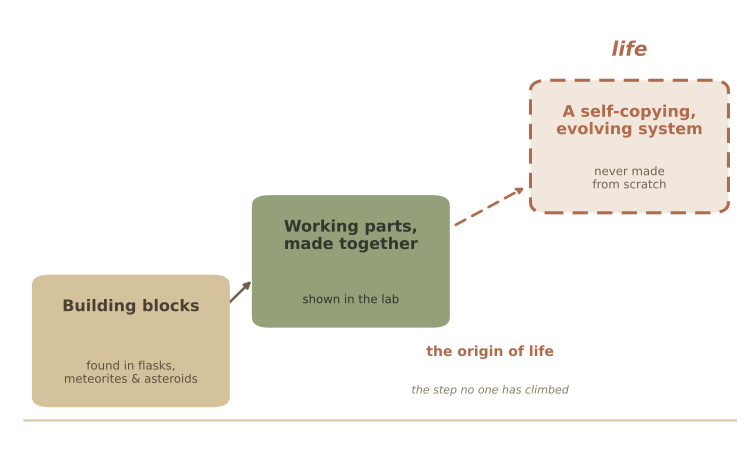
This is the true frontier, and honest researchers still divide over how to cross it. One camp says the secret is replication: get a molecule like RNA that can copy itself, and metabolism and membranes will follow. Another says the secret is metabolism: get a self-feeding cycle of reactions going first, and heredity comes later. A third builds tiny bubbles, protocells, and tries to make them grow, split, and compete. Decades in, the honest summary is that we have made every ingredient and much of the machinery, and we have never once watched non-life become life. Not in a flask, not on an asteroid, not anywhere.
What actually separates them
Three achievements, one word, “life,” stretched over all of them, and wildly different footing.
Finding the ingredients is solid, measurable, and real, and it tells you nothing about how they came alive. Arguing that physics makes life inevitable is bold and famous, and it has never bridged the gap from a suggestive law to a single living cell. Explaining the jump itself, the actual origin, sits right where it has always sat, unmade, unwatched, its distance unknown.
The confusion comes from folding three verbs into one. And the fix reaches far beyond biology:
Finding a part everywhere tells you it is cheap, not that it wants to become you. Abundance is not assembly, and availability is not inevitability.
You can fill the universe with amino acids and come no closer to knowing why they ever started copying themselves. You can write an elegant law about energy and matter and still not touch the question of whether that law makes life or merely permits it. Common ingredients prove a meal is possible. They never prove it will cook itself.
So, is life inevitable?
The honest answer is that we do not know. And the freshest reasons to care are exactly the ones in the news.
What has genuinely changed is that we now know life’s parts are cheap and common, made in flasks and scattered across space. That is real, and it nudges the odds: if the bricks are everywhere, life is at least possible in far more places than we used to think. But “possible in many places” is not “inevitable,” and the one result that would prove inevitability, chemistry crossing on its own into something that lives and evolves, is precisely the result no one has ever produced. Until someone does, the claim that physics makes life unavoidable is a hypothesis wearing the clothes of a discovery.
The new tools sharpen the point rather than settle it. Artificial intelligence can now sort through staggeringly large libraries of possible reactions, mapping the maze of chemistry faster than any human could, hunting for plausible routes from simple molecules to complex ones. That is a magnificent search engine. It maps the maze; it has not found the exit. Telescopes, meanwhile, are reading the air of planets light-years away for the exhaust of alien life. The most talked-about case, a possible trace of a life-made gas on a world called K2-18b, has already been walked back by other teams as too faint to trust. Even out there, we are still finding hints, not answers.
So the useful move is not to ask which breakthrough finally explains the origin of life. It is to keep the three verbs apart. Of any new headline, ask a simple question: is it finding, arguing, or explaining? Almost all of the good news is finding. Some of the loud news is arguing. And the thing in the title, the actual spark from chemistry to life, is still, quietly, unmade.
These advances are not erasing the line between dead chemistry and living biology. They are drawing it, more sharply than ever, right up to the edge of the one step we cannot yet take. And a line drawn honestly at the edge of the unknown is worth far more than a headline pretending the edge is not there.
Sources
- Miller, S. L. (1953). A Production of Amino Acids Under Possible Primitive Earth Conditions. Science 117, 528. (The original spark-discharge experiment; amino acids from gas, water, and electricity.)
- Bada, J. L. & Lazcano, A. (2003). Prebiotic Soup: Revisiting the Miller Experiment. Science 300, 745. (Why the assumed strongly reducing atmosphere is now doubted, and what that does to the classic result.)
- Johnson, A. P. et al. (2008). The Miller Volcanic Spark Discharge Experiment. Science 322, 404. (Rerunning the spark under volcanic, hydrogen-rich conditions yields even more amino acids than Miller reported.)
- Oba, Y. et al. (2023). Uracil in the carbonaceous asteroid (162173) Ryugu. Nature Communications 14, 1292. (An RNA letter, plus vitamin B3, in pristine asteroid dust returned by Hayabusa2.)
- Glavin, D. P., Dworkin, J. P. et al. (2025). Abundant ammonia and nitrogen-rich soluble organic matter in samples from asteroid (101955) Bennu. Nature Astronomy 9, 199. (The Bennu inventory: 33 amino acids, 14 of the 20 protein amino acids, all five nucleobases, ammonia, and evidence of ancient brines.)
- England, J. L. (2013). Statistical physics of self-replication. The Journal of Chemical Physics 139, 121923. (The thermodynamic argument that driven matter is pushed toward dissipation, and that self-copying is one way to dissipate more; the seed of “dissipation-driven adaptation.”)
- Patel, B. H., Percivalle, C., Ritson, D. J., Duffy, C. D. & Sutherland, J. D. (2015). Common origins of RNA, protein and lipid precursors in a cyanosulfidic protometabolism. Nature Chemistry 7, 301. (One set of starting molecules yielding the precursors of RNA, proteins, and membranes together.)
- Szostak, J. W., Bartel, D. P. & Luisi, P. L. (2001). Synthesizing life. Nature 409, 387. (The protocell and RNA-world program: what it would actually take to assemble a minimal living, evolving system, and why it is so hard.)
- Taylor, J. (2025). Is There Any Evidence for a Biosphere on K2-18b? A Reanalysis of the Available Data. The Astronomical Journal. (One of several teams concluding the claimed biosignature is too weak to support a detection of life.)