

Academic life is often framed as a calling, yet for many mid-career PhD students, the reality of the daily grind involves a persistent, gnawing question: should I quit or push through? The dissonance between the idealized vision of scientific discovery and the structural pressures of the laboratory, limited funding, uncertain career trajectories, and the high-stakes demand for productivity, has led many to reconsider the value proposition of their path. When a researcher notes that they find more personal agency and clarity in manual labor than in a biotech career, they are not necessarily expressing a loss of intellectual capacity. They are highlighting a fundamental mismatch between the incentive structures of modern science and the human requirements for sustainable work.
The Structural Realities of Choosing to Stay or Leave
Deciding whether to continue a doctoral program or transition out of academia is rarely a binary choice between success and failure. Instead, it is a strategic evaluation of sunk costs versus future utility. Many students report being trapped by the high pressure and low quality of life, often citing poor mentorship or a lack of institutional support as the primary drivers of their distress.
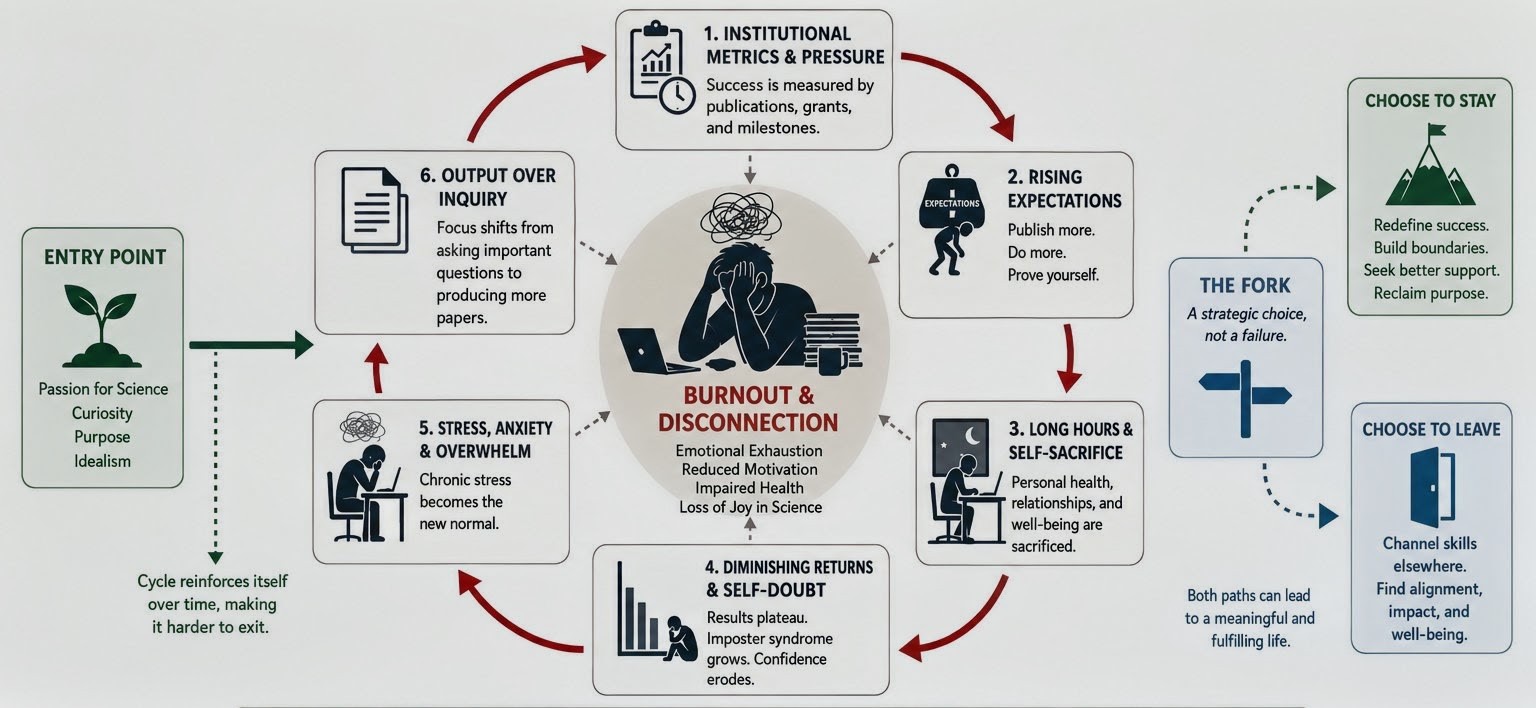
The pressure to perform is often decoupled from the actual practice of science. In an environment where the metric of success is the accumulation of publications rather than the resolution of complex problems, the researcher becomes an object optimized for output. This environment does not just test a student’s resilience; it tests their ability to sacrifice personal health for the sake of institutional metrics that may not align with their long-term professional or personal goals.
The Cognitive Cost of Ambiguity
The struggle to make a decision, to stay or to leave, is itself a taxing cognitive load. When a student spends months or years debating their future while under the weight of their current responsibilities, they effectively occupy a state of professional paralysis. This state is often worsened by the stigma surrounding those who exit the academic track.
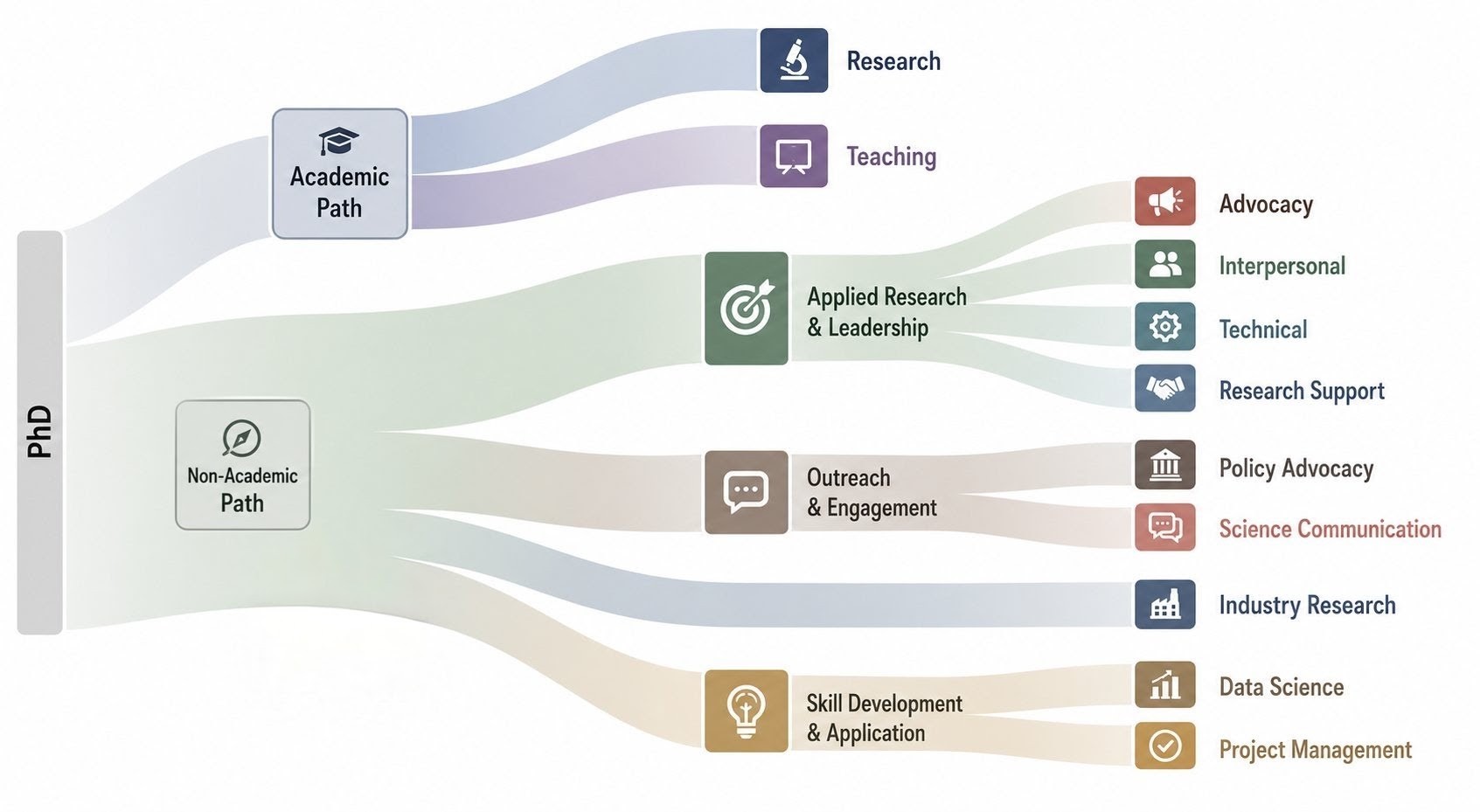
However, the assumption that leaving academia constitutes a departure from science is a category error. A scientist’s training is defined by the development of analytical frameworks, systematic inquiry, and the capacity to handle evidence-based decision-making. These are durable, transportable skills. When you evaluate your path, the question is not whether you are “giving up on science.” The question is whether the current environment provides the necessary conditions for you to apply your scientific training effectively. If the answer is no, the act of leaving is not an abandonment of your identity as a scientist, but a reallocation of your labor toward a system that might value or utilize it more appropriately.
Re-evaluating the Value of the PhD
The decision to stay or leave often hinges on a misapprehension of what the PhD represents. We are taught to view the degree as an end in itself, the culmination of a singular path toward a tenure-track position. But the reality for most is that the PhD is a tool, not a lifestyle.
The most common mistake researchers make is treating their career path as a fixed trajectory that requires constant validation through external markers of success. By clinging to the traditional academic script, you invite the very frustration that leads to the desire to walk away entirely. The most effective way to navigate this transition, or to decide to stay, is to decouple your self-worth from the structural outputs of the lab. Recognize that the system’s failure to provide a stable, healthy work environment is a systemic limitation, not a personal deficiency. When you stop viewing your professional life as a test of your personal character, the decision to leave becomes a rational professional adjustment rather than a crisis of identity.
The twist is that the very skills required to navigate the high-pressure, low-reward environment of academia, resilience, analytical rigor, and the ability to manage complex, often frustrating data, are the exact same skills that allow you to succeed in any other sector, yet the culture of academia relies on convincing you that these skills are only valid if they are applied within the lab walls.