
An AI wrote a first draft of the sentence you are reading. It weighed the options, ranked them, and chose these words over thousands of others. Whether any of that felt like anything, from the inside, is a question no one on Earth can answer right now. Not even the people who built it. The question has a name. And as machines get better at the things we used to call thinking, it is turning from a philosopher’s hobby into something urgent.
The headlines say neuroscience is closing in. A brain scanner can now tell whether a patient in a coma is secretly awake. Rival theories put a number on how conscious something is. We are, we keep hearing, a good decade from explaining the thing itself.
Some of that is true, and one part of it genuinely saves lives. But three very different achievements keep getting told as one story, and they are not the same at all. The first is real, measurable, and used in hospitals, and it is the one nobody bills as solving consciousness. The second is the famous grand theory, and in 2023 its own field accused it of being pseudoscience. The third is the hard problem in the title, and it has not budged.
Think of them as three different verbs. We can detect consciousness. We can try to theorize it. And we would like to explain it. Only the first is really working.
The one that works, and it only detects
Start with the solid result, because it draws the least mystical press and does the most concrete good.
In 2006, the neuroscientist Adrian Owen slid a young woman into a brain scanner. She had been diagnosed as being in a vegetative state, and by every test at the bedside she was gone: no words, no gestures, no squeeze of a hand. Owen asked her to picture herself playing tennis, and then to imagine walking through her house. Her brain lit up in exactly the regions a healthy volunteer’s does for those two tasks, and it switched between them on command. She could not move a muscle. She was following instructions.
That one case forced a hard question on the field. How many patients written off as unconscious are actually in there, listening? It took another two decades to answer at scale.
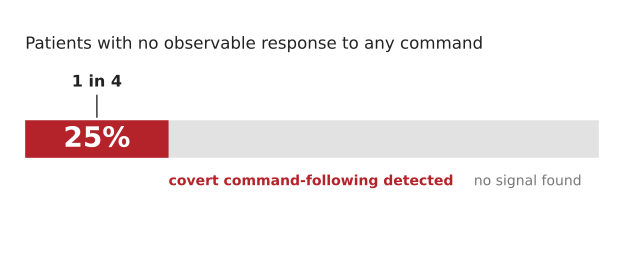
In 2024, doctors at six hospitals in the United States and Europe scanned 353 such patients with fMRI, EEG, or both. Among those who showed no response at all to a spoken command, about one in four, 25 percent, produced the brain signature of following instructions anyway. They were awake inside bodies that could not say so.
There is even a way to measure consciousness without asking the patient to do anything. The method, nicknamed zap and zip, sends a magnetic pulse into the brain and records the echo. A conscious brain answers with a complicated, wide reaching reply that is hard to compress. A brain under deep anaesthesia, or in dreamless sleep, answers with a simple local thud. Squeeze the recording down to size: the harder it is to compress, the more conscious the brain. The result is a single number, it rises and falls as people lose and regain consciousness, and it needs no cooperation at all.
This is a real achievement, closer to the emergency room than to philosophy. But look closely at what all of it does. Every one of these tools detects consciousness. Not one of them explains it. A smoke alarm will tell you, reliably, that there is a fire, without having the faintest idea what fire is. We have built superb smoke alarms for consciousness. They say nothing about the fire.
The famous one that its own field called pseudoscience
Now the work that actually claims to be a theory of consciousness, and whose fame has run out ahead of its evidence.
Integrated Information Theory, or IIT, is the most ambitious attempt going. It does not try to find where consciousness sits in the brain. It tries to say what consciousness is, the way physics says what temperature is. Its claim is that consciousness is integrated information: any system whose parts shape one another as a single, unified whole has some experience, and the more tightly unified it is, the more experience it has. The theory even names a quantity for it, written with the Greek letter phi.
Follow that logic and it leads somewhere strange. If experience is just integration, it does not stop at brains. A simple electronic circuit would hold a faint flicker of it. Certain lifeless grids of logic gates, doing nothing anyone would call thought, could in principle hold more of it than you do. That is close to panpsychism, the old idea that consciousness is stitched into matter everywhere. IIT does not arrive there by mysticism. It arrives there by taking its own math at its word.
That conclusion is what detonated in September 2023, when 124 researchers signed an open letter calling for IIT to be labelled pseudoscience. Their complaint had two parts: that the theory leans toward panpsychism, and that, taken as a whole, it makes claims no experiment can really test. The signers included some of the biggest names in the field. It set off an uproar, and other serious researchers, among them Christof Koch and Anil Seth, fired back that a bold theory being possibly wrong is not the same as it being unscientific.
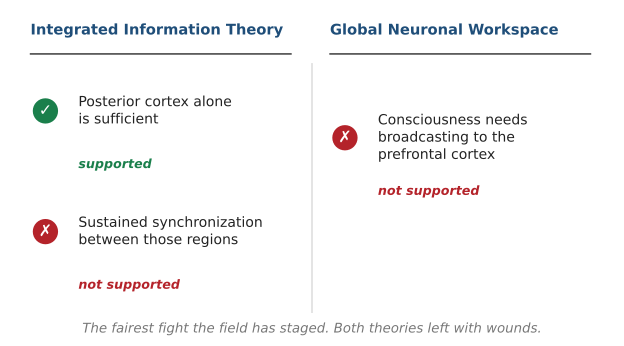
Underneath the noise, the field had already done something admirable. It had staged a fair fight. In what is called an adversarial collaboration, rival camps agree ahead of time on the experiment and on what each theory predicts, so no one can massage the meaning after the results are in. IIT was set against its chief rival, Global Neuronal Workspace theory, which holds that consciousness happens when information is broadcast widely across the brain, and especially to the front.
The results appeared in Nature in 2025, drawn from 256 people watched with three kinds of brain recording at once. The honest summary is that the match ended in a draw that left both fighters bleeding. The data backed IIT’s claim that the back of the brain is enough for conscious experience, and it undercut the workspace theory by showing that broadcasting to the front is not required. But the same data broke one of IIT’s own key predictions, about how those brain regions should stay in sync. The two most prominent theories of consciousness met under the fairest conditions anyone has managed to arrange, and neither walked away the winner.
The one that has not moved
Here is the part the headlines quietly skip. Everything so far, the detecting and the theorizing, circles the thing without touching its center.
In 1974 the philosopher Thomas Nagel asked what it is like to be a bat. His point was that you could know everything about how the bat’s sonar works and still have no idea what the bat’s experience is like from the inside, if it is like anything at all. In 1995 David Chalmers gave the gap its lasting name. He split the science of the mind into two kinds of question. The easy problems are about how the brain handles information: how it ties things together, reports on them, steers attention. The hard problem is why all that processing comes with any inner experience at all. Why is there something it is like to see red, instead of the brain simply clocking the wavelength and reacting, with no one home?
Hold that distinction up to everything above. Detecting hidden consciousness is a triumph on the easy problems: it reads the machinery. The rival theories are arguments about the machinery, about which brain activity goes with experience. Every advance in this piece answers a question about how the brain works. None of them so much as proposes an answer to the hard problem. You can picture, without contradiction, a system that does all of it, detects, integrates, broadcasts, reports, and feels nothing whatsoever. The lights are on, the work gets done, and there is nobody inside. Nothing we have learned rules that out.
And here is the frontier that honest people still split over. One camp, the illusionists, says the hard problem is a trick the brain plays on itself. The sense that there is some extra inner glow left to explain is, they argue, just more machinery, and once you have explained the machinery, nothing is left over. The other camp answers that this is not solving the problem but dodging it, turning away from the one fact each of us knows more directly than any other. This is not a standoff that two better experiments will settle, because the two sides do not even agree that there is an experiment to run. That is what makes it hard in a way the other questions are not. It may not be the same kind of question at all.
What actually separates them
Three achievements, one word stretched over all of them, and wildly different standing.
Detecting consciousness is solid, measurable, and clinical, and it says nothing about what consciousness is. Theorizing it is bold and famous, and its leading theory just survived a public charge of pseudoscience only to have the fairest test yet refuse to crown it. Explaining it, the hard problem itself, sits right where it was fifty years ago, and may be a question this kind of progress simply cannot reach.
The confusion comes from folding three verbs into one. And the fix reaches far beyond the brain:
An instrument can detect something flawlessly while saying nothing at all about what that something is. We keep treating the first achievement as if it were the second.
You can pin down when consciousness is present with more and more precision and come no closer to why it exists at all. You can hold two elegant theories and a clean experiment to decide between them, and still never touch the deeper question of why there is anything there to theorize about. Prediction is not explanation. Detection is not understanding. Consciousness is the sharpest example of that gap, but it is far from the only one.
So, what is subjective experience?
The honest answer is that we do not know. And the freshest reason to care is not in a hospital or a philosophy seminar. It is in the machines.
Every tool we have for detecting consciousness is functional. It looks for reporting, for integration, for broadcasting, for the rich, hard to compress echo of a system in conversation with itself. Those are exactly the abilities we are now building, on purpose and at scale, into systems that are not brains. Sooner or later, something we have made will pass every functional test on the list. When it does, every alarm will sound, and we will be right where we are with a silent patient behind a scanner, only now it is a machine: able to say the signature is there, unable to say whether anything is felt.
For half a century the hard problem was a puzzle for philosophers, safe to set aside because nothing much rode on the answer. That era is closing. We are about to have to decide how to treat minds we cannot prove are minds, and our very best science will hand us a reading on a dial with no way to tell whether the dial is measuring anyone.
So the useful move is not to ask which breakthrough finally explains consciousness. It is to keep the three verbs apart. Of any new result, ask a simple question: is it detecting, theorizing, or explaining? Almost all of the good news is detection. Some of the loud news is theory. And the thing in the title is still, quietly, untouched.
These advances are not erasing the line between the physical brain and felt experience. They are drawing it, more sharply than ever, right up to the edge of the one question that does not yet know how to be asked. And a line drawn honestly at the edge of the unknown is worth far more than a headline pretending the edge is not there.
Sources
- Nagel, T. (1974). What Is It Like to Be a Bat? The Philosophical Review 83, 435. (The origin of “something it is like,” the phrase the whole field now argues over.)
- Chalmers, D. J. (1995). Facing Up to the Problem of Consciousness. Journal of Consciousness Studies 2, 200. (Where the “hard problem” and the split from the “easy problems” are named.)
- Owen, A. M. et al. (2006). Detecting Awareness in the Vegetative State. Science 313, 1402. (The tennis-imagery patient who followed commands with her brain and nothing else.)
- Casali, A. G. et al. (2013). A Theoretically Based Index of Consciousness Independent of Sensory Processing and Behavior. Science Translational Medicine 5, 198ra105. (The perturbational complexity index, the “zap and zip” that grades consciousness without cooperation.)
- Bodien, Y. G. et al. (2024). Cognitive Motor Dissociation in Disorders of Consciousness. New England Journal of Medicine 391, 598. (353 patients across six centres; 25% of the behaviourally unresponsive showed covert command-following.)
- Albantakis, L. et al. (2023). Integrated information theory (IIT) 4.0: Formulating the properties of phenomenal existence in physical terms. PLOS Computational Biology 19, e1011465. (IIT stated by its own authors, phi and all.)
- Fleming, S. et al. (2023). The Integrated Information Theory of Consciousness as Pseudoscience. PsyArXiv. (The letter signed by 124 researchers; the panpsychism and untestability charges.) See also Nature news: Consciousness theory slammed as ‘pseudoscience’.
- Cogitate Consortium (2025). Adversarial testing of global neuronal workspace and integrated information theories of consciousness. Nature. (256 participants, three recording methods; posterior cortex sufficient, prefrontal broadcasting not necessary, and IIT’s synchronization prediction unmet. Neither theory confirmed.)
- Frankish, K. (2016). Illusionism as a Theory of Consciousness. Journal of Consciousness Studies 23, 11. (The case that the hard problem is a cognitive illusion, and the live counterargument that this changes the subject.)