
Think back to what you did when your computer started to crawl.
You did not open it up and replace parts. You wiped it and restored it from a backup, and it came back like new. Same machine, same drive, same everything. The only thing that changed was the state it had been holding.
Life has been doing exactly this for about a billion years.
There is an unbroken chain of cell divisions running from the first living cell on this planet to the one reading this sentence. Not a single link in it ever died. In that sense the cells you are made of are not thirty or forty or seventy years old. They are billions. What stops that chain from creaking with age is that at every generation, it gets restored from a backup.
Your parents’ cells had been alive for decades by the time they made you. You were born at zero. Somewhere in there, an age went missing, and nobody had to invent anything for that to happen.
You are a restore. Your child will be the next one.
Which sets up the question now worth three billion dollars: if life already knows how to do this, why will it not do it for you?
In 2020, a team at Harvard got closer to an answer than anyone expected. They made old mice see again.
Not partially, not statistically. They took mice whose eyesight had faded with age, and mice whose optic nerves had been crushed, delivered three genes into the cells at the back of the eye, and the vision came back. The nerve fibres regrew, which adult nerve fibres are famously not supposed to do.
Nothing was replaced. No stem cells were transplanted, no damaged tissue swapped out. The same old cells simply started behaving like young ones again. A restore, on a machine that was still running.
That result launched a metaphor: aging is not wear and tear, it is a software error. The hardware, your DNA, is fine. What degrades is the layer above it, the set of chemical annotations telling each cell which genes to read. Corrupt that, and a liver cell slowly forgets how to be a good liver cell. And software errors, unlike wear, can be undone.
It is the most exciting idea in aging biology. It is also the one most in need of someone reading the fine print.
The clock that started it
In 2013, Steve Horvath found something that should not have worked. He took 8,000 samples across 51 human tissues and looked at a specific kind of chemical tag on DNA, a methyl group, that switches genes on and off. From just 353 of those sites, he built a predictor of a person’s age.
It correlated with true age at 0.97, with a median error of 2.9 years. From a spot of blood, or a piece of almost any tissue, chemistry could tell your age better than most people’s guesses.
That is a genuinely strange fact. It means aging leaves a mark that is legible, consistent and quantitative, across the whole body at once.
But notice what a clock is. A thermometer predicts a fever with excellent accuracy, and smashing one has never cured anybody. Horvath’s clock is a superb measurement of aging. It is not evidence that the tags themselves are what makes you old, and this distinction is where a great deal of money now sits.
The reset button, and its price
We have known how to wind that clock back since 2006, when Shinya Yamanaka showed that four genes, now universally called the Yamanaka factors, could take an ordinary adult skin cell and walk it all the way back to an embryonic state. It won a Nobel Prize in six years, which is close to a record.
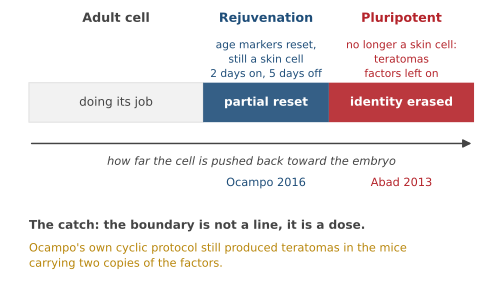
Wind a cell back that far and its epigenetic clock resets to nearly zero. The problem is what else resets. A cell driven all the way back is no longer a skin cell. It has forgotten its job entirely, and a cell with no job and unlimited growth potential has a name in medicine: a tumour.
This is not theoretical. In 2013, Manuel Serrano’s group turned the four factors on in living mice and left them on. The mice grew teratomas, the vivid kind of tumour that sprouts several tissue types at once, in stomach, intestine, pancreas and kidney.
So the reset button works. Held down, it kills you.
The narrow window
The obvious idea is to tap the button instead of holding it. Push the cell partway back, far enough to clear the age markers, not so far that it forgets its trade.
In 2016, Alejandro Ocampo and Juan Carlos Izpisua Belmonte did exactly that: two days on, five days off, cycling. It worked. Their mice showed reversed aging markers and lived longer, and the effect ran through the epigenetic machinery rather than around it, since blocking a specific methylation enzyme abolished it.
Here is the fine print that mostly does not survive the trip into headlines.
Those were progeroid mice. They carry a mutation causing a rare disease that makes them age extraordinarily fast, and they die young. Extending their lives is a real achievement, but it is closer to correcting a specific defect than to slowing ordinary aging. In their normal aged mice, Ocampo’s team reported better recovery from muscle injury and metabolic disease. Good results. Not longer lives.
And the teratomas did not vanish. Ocampo’s paper reports them appearing in the mice carrying two copies of the factors, on the very same cyclic protocol. The safe window is not a place, it is a dose, and the dose that rejuvenates a mouse is uncomfortably close to the dose that gives it tumours.
What has actually been shown
Line the good results up and a shape appears.
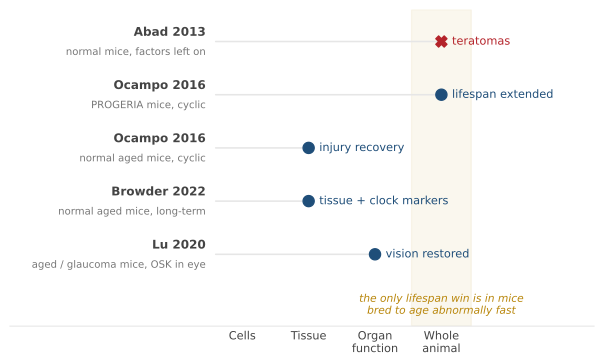
The strongest claim, longer life, comes from mice bred to age abnormally fast. The most beautiful result, Lu’s returning vision in 2020, is one cell type in one organ, though it is reassuringly safe: fifteen months of continuous expression in the retina produced no tumours at all. The 2022 work from Belmonte’s group, running partial reprogramming long-term in ordinary aging mice, reported rejuvenated tissue and a reversed epigenetic clock. Tissue markers, again, not lifespan.
Nobody has yet shown that partial reprogramming makes a normal animal live meaningfully longer.
That is not a scandal. The field is about ten years old and the experiments are brutally slow, because the honest version takes a mouse’s entire lifetime. But it is the gap between what has been demonstrated and what the metaphor promises, and the metaphor is what raised the money. Altos Labs launched in 2022 with three billion dollars, Bezos among the backers and Yamanaka himself advising.
Is aging really information loss?
The boldest version of the claim arrived in 2023, when David Sinclair’s group published in Cell a paper arguing that losing epigenetic information does not merely accompany aging but causes it.
They engineered mice to accumulate DNA breaks that then got faithfully repaired. No mutations, no damage left behind, just repair happening over and over. The mice aged faster anyway. The proposed mechanism is that each repair job pulls the epigenetic machinery away from its normal post, and it never quite finds its way back, so the annotations blur a little each time. Their epigenetic clocks ran roughly 50 percent fast, and OSK partially reversed it.
If that is right, aging is genuinely an information problem, and the metaphor is not a metaphor at all.
It is one paper, and it is formally contested. In 2024, James Timmons and Charles Brenner published a challenge in Cell itself, under the flat title “The information theory of aging has not been tested”. Their argument is that the tool doing the cutting is known to be toxic in its own right, so the mice may be suffering from the engineering rather than from lost information, and that the paper showed no old tissue with function actually restored. Sinclair’s group published a reply in the same issue, arguing the dose was kept low enough to avoid exactly that.
Read both. It is four pages, it is the clearest window into how this field actually argues, and it is a useful antidote to the way the original paper gets cited as settled.
Your past is your future
Now back to the restore, because it is stranger than I let on at the start.
In 2021, Csaba Kerepesi and Vadim Gladyshev’s group ran the epigenetic clock through embryonic development, in mice and in humans, to watch what it actually did. In the earliest days, it runs down. Biological age falls to a minimum, which they named ground zero, and only from there does it begin to climb.
So a baby does not begin at zero. It is taken to zero. The clock runs backwards first.
That is a restore, in the strict sense. Not a fresh machine, not new parts. The same billion-year-old chain of cells, wound back to a known good state, then allowed to run forward again. It has happened at every generation of every sexually reproducing species since there were two of anything, which makes it the most thoroughly tested procedure in all of biology, and we have never once been invited to watch it closely enough to copy it.
That is the sense in which your past is your future. The oldest thing you carry, the line itself, is also the newest thing you will ever make. Nature solved aging a long time ago and solved it completely. The solution was never repair. It was to restore.
The catch, and it is the whole catch, is that the thing restored is never you. That was the deal: the line stays young forever, and the body it builds is scaffolding, permitted to come down once the work is done. Your child is your own cells at ground zero. You are the machine the backup was taken from.
Reprogramming is the first serious attempt to break that deal. To take the one procedure life will only run between bodies, and run it inside one, on a machine that cannot be switched off first.
So, is aging a reversible software error?
We have a spectacular measurement, a working reset button, one strong causal claim under formal dispute, and a proof of concept that has been running for a billion years somewhere we cannot reach.
What we have to work with is a dial nobody can read yet, in a room with the lights half on. Turn it a little and cells get younger. Turn it too far and they turn cancerous. The embryo turns it all the way to the floor and somehow does not. Whatever safety mechanism it uses, we do not have, and until we do, every trial is a search for a boundary whose only two ways of being found are to wait and to be wrong.
So the useful question is not whether aging is reversible. Nature settles that one every time a child is born. It is whether rejuvenation can be pulled apart from uncontrolled growth cleanly enough to bet a healthy person’s life on it, in one body, without starting over. That is a narrower question, a slower one, and it is what the three billion dollars is actually buying.
Life is not software. But it does keep a backup of itself, it has always known how to restore from it, and it has never once done so for the benefit of the body you are standing in.
So count yourself the way the line counts, from the first cell instead of from your birthday, and one last inversion falls out of it.
You were born older than your parents were born. They were born older than your grandparents were. The chain that arrives at you is the longest one your family has ever held, because it is theirs plus everything that has happened since, and each generation is handed more of it than the last.
And each generation is handed it at zero.
Both of those are true at once. Everything in this field is an argument about the distance between them.
Sources
- Takahashi, K. and Yamanaka, S. (2006). Induction of pluripotent stem cells from mouse embryonic and adult fibroblast cultures by defined factors. Cell 126, 663–676.
- Horvath, S. (2013). DNA methylation age of human tissues and cell types. Genome Biology 14, R115.
- Abad, M. et al. (2013). Reprogramming in vivo produces teratomas and iPS cells with totipotency features. Nature 502, 340–345.
- Ocampo, A. et al. (2016). In vivo amelioration of age-associated hallmarks by partial reprogramming. Cell 167, 1719–1733.
- Lu, Y. et al. (2020). Reprogramming to recover youthful epigenetic information and restore vision. Nature 588, 124–129.
- Browder, K.C. et al. (2022). In vivo partial reprogramming alters age-associated molecular changes during physiological aging in mice. Nature Aging 2, 243–253.
- Yang, J.-H. et al. (2023). Loss of epigenetic information as a cause of mammalian aging. Cell 186, 305–326.
- Timmons, J.A. and Brenner, C. (2024). The information theory of aging has not been tested. Cell 187, 1101–1102.
- Yang, J.-H. et al. (2024). Response to: The information theory of aging has not been tested. Cell 187, 1103–1105.
- Kerepesi, C. et al. (2021). Epigenetic clocks reveal a rejuvenation event during embryogenesis followed by aging. Science Advances 7, eabg6082.
- Altos Labs launched in January 2022 with $3 billion in committed funding: Chemical & Engineering News.