
Search for a LaTeX proofreader and you will find a healthy handful of tools, all promising to polish your paper without wrecking your code. Most of them deliver on that promise. The question this comparison actually asks is the one the marketing pages tend to skate past: which of them reads your equations?
Everything below is drawn from each tool’s own public description as of July 2026. Where a tool is strong, it is credited. The differences that matter for a scientific manuscript are narrower, and more important, than the feature lists suggest.
The comparison at a glance
| Trinka | SciSpace | ProofreaderPro | GenAI LaTeX Proofreader | Benjamin | |
|---|---|---|---|---|---|
Reads .tex without breaking it | ✓ | ✓ | ✓ | ✓ | ✓ |
| Proofreads the prose | ✓ | ✓ | ✓ | ✓ | ✓ |
| Context-aware proofreading | ✓ | ✓ | ✓ | ✓ | ✓ |
| Reads inside display equations | limited | not documented | ✗ (placeholders) | ✗ | ✓ |
| Proofreads equations (checks the math is right) | ✗ | ✗ | ✗ | ✗ | ✓ |
| Checks units and dimensions | ✗ | ✗ | ✗ | ✗ | ✓ |
| Checks notation consistency | ✗ | ✗ | ✗ | ✗ | ✓ |
| Tracked changes | ✓ Word | ✗ | ✓ | report file | ✓ Word or inline LaTeX diff |
| Style guides (APA, IEEE, …) | ✓ | partial | partial | ✗ | ✓ |
| Languages | ~7 | English-first | English-first | model-dependent | 95+ |
| Best for | language polish | quick cleanups | Overleaf workflow | developers | reading the science |
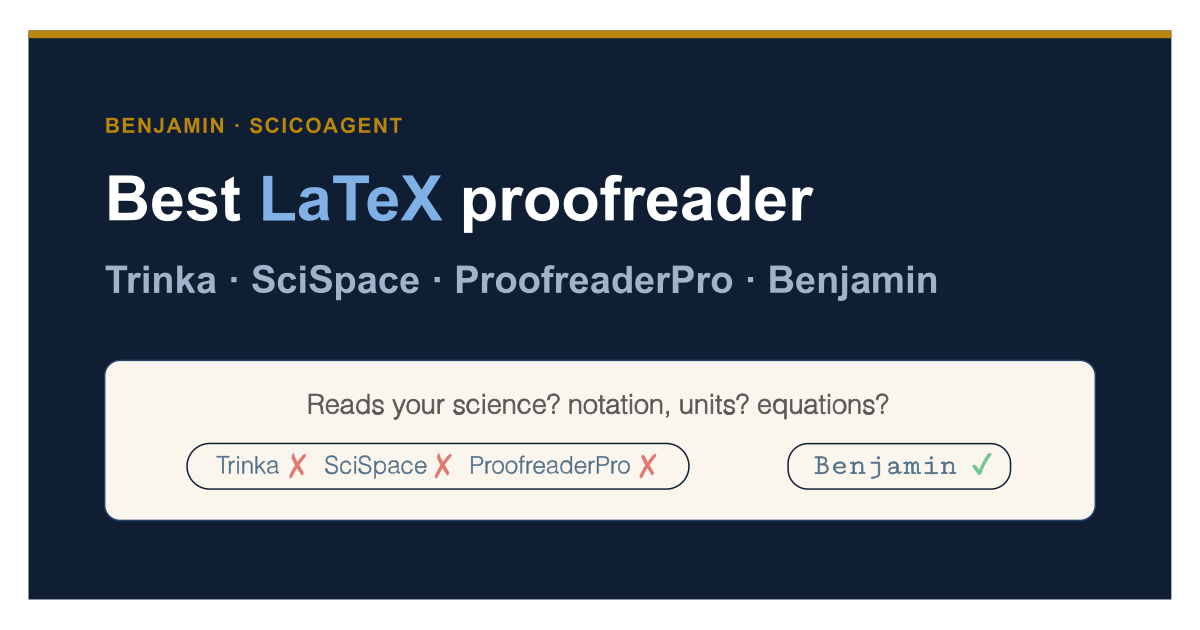
Two rows decide this table. Every tool here keeps your .tex intact and improves your prose, and the AI-based ones read that prose in context. Only one reads and then proofreads the equations, the units and the notation, which is the layer most likely to send a manuscript back. The rest of this page is the fair detail behind each column.
Trinka
Trinka is the most complete of the language-first tools. It keeps your LaTeX code intact, returns an MS Word file with tracked changes plus a clean .tex, and adds genuinely useful academic features: style-guide enforcement (APA, AMA, IEEE and others), subject-area personalization, and a revision breakdown by category. It supports roughly seven languages and can edit files pulled from Overleaf.
Where it stops is the mathematics. Trinka’s own materials emphasize preserving the integrity of your LaTeX and improving the language. It is excellent at making your English publication-ready. It is not built to tell you that the exponent in Equation 7 is wrong, or that your diffusion coefficient has the units of a velocity.
Best for: authors who mainly need strong, style-guide-aware language editing and a Word track-changes deliverable for co-authors.
SciSpace
SciSpace offers a LaTeX Proofreading Agent with a clean workflow: paste your .tex, review the suggestions, export a tidied draft. It focuses on language, clarity and structure, and it is convenient for a quick pass. It is English-first and, like the others, aims at the prose rather than the equations.
Best for: a fast clarity-and-language cleanup when you do not need deep scientific checking.
ProofreaderPro
ProofreaderPro is the content-led option, with a well-written workflow for proofreading Overleaf projects and a tracked-changes output. Its published method is candid about how it handles math: replace inline $...$ with placeholders and set the display equations aside, then paste them back afterward. That keeps the file compiling, and it means the equations themselves are not proofread.
Best for: authors who want a documented prose workflow for Overleaf and are comfortable checking the math themselves.
GenAI LaTeX Proofreader
GenAI LaTeX Proofreader is the open-source entry, on GitHub. It runs your paper through generative AI and appends the suggestions back into the LaTeX source as a proofreading report. It suits developers who want a self-hosted, scriptable pipeline and do not mind assembling the workflow. It does not provide the reviewed, accept-or-reject tracked-changes experience the commercial tools offer.
Best for: developers who want a free, self-hosted starting point to build on.
Benjamin
Benjamin is the outlier, on purpose. He does everything the language-first tools do, keeps your .tex intact, proofreads the prose, returns tracked changes, and then keeps going into the layer the others leave alone. He reads the mathematics: a summation that double counts, a wrong exponent, a unit that cannot be right, an operator posing as a variable, a symbol that drifts partway through the paper. You can take the result as native Word Track Changes or as an inline LaTeX diff, in any of 95+ languages, across LaTeX, Word, Markdown and RTF.
The trade-off is honest: if all you need is a fast English polish, a language-first tool will get you there and some are very good at it. If the part of your paper that keeps you up at night is the math, Benjamin is the only one on this list built to read it.
Best for: scientists whose manuscripts live or die on the equations, units and notation, and who want those read, not just protected.
How to choose
Line up the tools against the errors you are actually worried about.
- If your worry is awkward English and journal style, Trinka is a strong pick.
- If your worry is a quick clarity pass, SciSpace is convenient.
- If your worry is a documented Overleaf workflow, ProofreaderPro fits.
- If your worry is building your own pipeline, GenAI LaTeX Proofreader is the open-source base.
- If your worry is a wrong exponent, an impossible unit, or a notation collision surviving to review, that is the specific gap Benjamin was built to close.
For the longer argument behind that last row, see why proofreading your English while ignoring your math is proofreading the wrong half of the paper.